



The community was always welcoming. The people currently attacking vibe-coders either weren't around for that — or they forgot.
Been in this for a while
I've been in technology since I was born, essentially. The people around me initiated me into the field — and it's been at least since 2000. In all that time, the community was always the same: friendly, generous, and genuinely excited to share.
I discovered HTML and CSS early on. Dabbled in JavaScript, then PHP. I hosted and ran non-steam Counter-Strike 1.6 servers, which meant maintaining the infrastructure yourself, protecting it from cheaters using tools like sXe Injected and whatever else was circulating at the time. Nobody solved that problem for you. You figured it out or the server went down. I learned WordPress more deeply through PHP, built more websites, wrote more scripts, created more automation. Then I picked up C# to script Ultima Online private servers — building interactions the game never shipped with, things that didn't exist until you wrote them yourself.
In the middle of all that, I read hundreds of articles on Le Site du Zéro (now OpenClassrooms) and Stackoverflow. Watched and applied more tutorials than I can count, mostly pre-YouTube.
The community was the same through all of it, welcoming to anyone willing to code, learn, and try to build something. Whether professionally or personally. That is the culture I grew up in. That is the culture that is still here.
What's actually bothering me
Just look at GitHub. The level of contribution and knowledge exchange has never been higher. With AI, these things come through one source you can double-check and improve on. The tools got better. The access got broader. That is supposed to be a good thing.
And to be honest, in the beginning I was doing a lot of things based purely on "it works." I didn't understand what pointers were. I was operating at the problem-solving level, using programming building blocks to fix problems. It was about ten years before I actually learned what pointers were — through a C course, and suddenly it all clicked. Now explaining it with AI is easy.
So what's bothering me is this stupid, small wave against vibe-coders that keeps surfacing everywhere. Who are these people?
I'd understand if this was about clicks. But it reads like the anti-AI wave from 18 months ago, just wearing a different label. That first front already collapsed on its own weight — and here they are, regrouped, aiming at a new target. Same crowd, same playbook, new label on the door.
Who are these guys
Honestly? I don't know exactly. And I have come to realize that doesn't matter.
The best answer to gatekeeping isn't outrage, it's outlasting it. Keep learning. Keep building. Work your way up the stack, layer by layer. At some point these people come back to their senses. They usually do, the archetype burns itself out the same way every time. And when they do, you will have something they didn't expect: actual knowledge and actual work to show for it.
At that point, do what this community was always good at. Share what you learned along the way. Welcome them in. The door was open for you — leave it open for them.
Welcome to the community — here's how to level up
I should have opened with this, but: welcome. The community was always this open. You belong in it from day one.
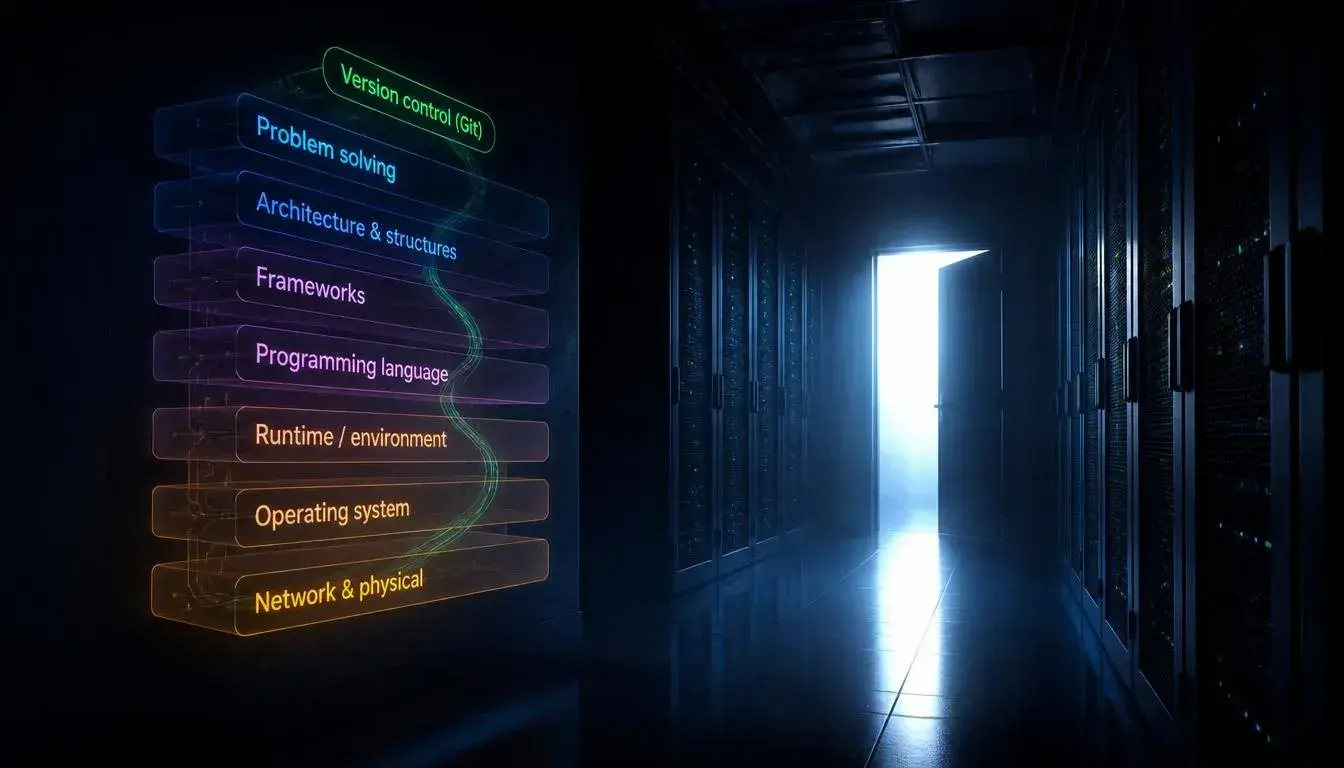
There's a path from vibe-coder to what I'd call a self-aware vibe-coder — which is essentially a senior developer who uses AI the same way you do, except with a mental model of the full stack. You manage flows through architectures and structures. You don't need to understand how your CPU executes instructions to ship something valuable today. But understanding the layers below you makes you faster, harder to fool by a bad AI suggestion, and much better at knowing when something is overengineered.
Here's how the stack actually looks — from the layer you already operate in, down to the physical foundation everything runs on. Git sits apart from this stack on purpose: it isn't a layer you pass through, it's a safety net wrapped around all of them.
The goal isn't to memorize every layer at once. Know they exist. Know roughly what they do. Let that map inform the questions you ask. When the AI suggests an architecture, ask yourself: does this fit the shape of my problem, or is it overkill? That judgment is what separates a vibe-coder from a self-aware one.
Git doesn't sit at any one layer — it wraps around all of them, and it belongs in your hands immediately. Whether you're shipping a feature, swapping frameworks, or refactoring around a new language, your code has a history. Every decision is recoverable. That safety net is what makes experimentation cheap — try the AI suggestion, see if it works, roll back if it doesn't. Learn it before anything else.
The question you should always be asking
Whatever you're building — frontend or backend, small script or full product — the question is always the same: what's the best architecture for this problem? Not the most impressive one. Not the one the AI suggested first. The one that fits the actual shape of what you're solving, the same way you'd choose the right blocks and restone components in Minecraft for what you're actually building.
Document what you do. Not for anyone else — for yourself. The act of writing down what you built and why forces the architecture into your head. Over time, that library of decisions becomes instinct. That instinct is what the people attacking you claim to have — and can't demonstrate in a daily basis.
Send this to anyone who's been told they don't belong in this field because they used AI to get started. Vibe-coders are ahead of where I was in my first decade. The community always had room for people who showed up to build — it still does.